ENFERMERÍA CUIDÁNDOTE - ISSN 2695-9364
Rodríguez Martínez A. Assessment of the perception of self-care among adolescents in Andalusia
Assessment of the perception of self-care among adolescents in Andalusia
Valoración de la percepción de autocuidado de los jóvenes andaluces
Author:
- Antonio Rodríguez Martínez
 . Poniente University Hospital (Hospital Universitario Poniente). El Ejido. Almeria. Spain.
- Antonio Rodríguez Martínez. Poniente University Hospital (Hospital Universitario Poniente). El Ejido. Almeria. Spain.
E-mail: Antorodri8@gmail.com
- 09/12/2025
- 06/02/2026
- 06/05/2026
- Rodríguez Martínez A. Assessment of the perception of self-care among adolescents in Andalusia. Enferm Cuid. 2026;9. https://doi.org/10.51326/ec.9.2797837
 Las obras se publican en esta revista bajo una licencia Creative Commons Attribution 4.0 International License (CC BY 4.0) que permite a terceros utilizar lo publicado siempre que mencionen la autoría del trabajo y a la primera publicación en esta revista.
|
Abstract Introduction: Given the growing concern surrounding risk behaviors in adolescence and the limited exploration of self-care from a multidimensional perspective, this study is justified by the need to analyze this phenomenon in a comprehensive manner. Objectives. The overall objective was to assess the level of self-care among young people in Andalusia and analyze its variations following the COVID-19 pandemic. Specifically, we sought to examine the relationship between self-care and the risk of eating disorders (EDs) and negative exercise addiction (NEA). Methodology. A mixed research design was used. The quantitative phase consisted of a cross-sectional study with a sample of 1,018 adolescents to validate the Youth Self-Care Practice and Management questionnaire. The qualitative phase was based on interviews with teachers to gain insight into the social and educational context. Results. The findings revealed a strong interrelationship between the self-care dimensions, confirming family support as a significant protective factor. Regression analysis identified that greater frequency of physical activity and self-care management were significant predictors of increased ED risk. For NEA risk, only physical activity was found to be a significant predictor. Discussion and Conclusion. The study validates the PGJ questionnaire as an effective tool for early risk detection. The findings conclude that it is essential to implement a comprehensive approach that actively involves families and educational centers to effectively promote healthy habits and well-being among adolescents. Keywords: Adolescent Health; Adolescents; Compulsive Exercise; Family Relations; Feeding and Eating Disorders; Health Risk Behaviors; Mental Health; Self Care; Social Support. |
|
Resumen Introducción: Ante la creciente preocupación por las conductas de riesgo en la adolescencia y la limitada exploración del autocuidado desde una perspectiva multidimensional, este estudio se justifica por la necesidad de analizar este fenómeno de forma integral. Objetivos. El objetivo general fue evaluar el nivel de autocuidado en jóvenes andaluces y analizar sus variaciones tras la pandemia de COVID-19. Específicamente, se buscó examinar su relación con el riesgo de Trastornos de la Conducta Alimentaria (TCA) y Adicción Negativa al Ejercicio (ANE). Metodología. Se empleó un diseño de investigación mixto. La fase cuantitativa consistió en un estudio transversal con una muestra de 1.018 adolescentes para la validación del cuestionario de Práctica y Gestión del Autocuidado Juvenil (PGJ). La fase cualitativa se basó en entrevistas con docentes para profundizar en el contexto social y educativo. Resultados. Los hallazgos revelaron una fuerte interrelación entre las dimensiones del autocuidado, confirmándose el apoyo familiar como un factor protector significativo. El análisis de regresión identificó que una mayor frecuencia en la práctica física y la gestión del autocuidado eran predictores significativos de un mayor riesgo de TCA. Para el riesgo de ANE, únicamente la práctica física resultó ser un predictor significativo. Discusión y Conclusión. El estudio valida el cuestionario PGJ como una herramienta eficaz para la detección precoz de riesgos. Se concluye que es fundamental implementar un enfoque integral que involucre activamente a las familias y los centros educativos para promover eficazmente hábitos saludables y el bienestar en la población adolescente. Palabras clave: Adolescentes; Apoyo Social; Autocuidado; Conductas de Riesgo para la Salud; Ejercicio Compulsivo; Relaciones Familiares; Salud del Adolescente; Salud Mental; Trastornos de la Conducta Alimentaria. |
|
Introduction Self-care is defined as the set of intentional actions that individuals undertake to control internal and external factors that may affect their life and development1,2. This concept is crucial during adolescence, a vital stage for the consolidation of habits that will continue into adulthood. Despite its strategic importance, self-care has been underexplored in the social sciences and had been predominantly addressed by health disciplines such as medicine or nursing, which focus on the prevention and treatment of diseases3,7. Although awareness campaigns target young people, rates of overweight, eating disorders (EDs), substance use, and sexual risk behavior have steadily increased. There is a notable discrepancy between adolescents' optimistic perception of their habits and the reality observed by health professionals, highlighting a gap in self-awareness and self-health management8. Current research on youth self-care has significant limitations. Most studies focus on descriptive profiles of what young people do to take care of themselves, without delving into the factors that influence these behaviors9-12. In addition, interventions and management models have focused almost exclusively on medical contexts and populations with existing pathologies, using a variety of specific questionnaires for each dimension or disease rather than a unified instrument that offers a comprehensive view13-21. This study is justified by the need to overcome these limitations through the creation and validation of a multidimensional instrument, the Youth Self-Care Practice and Management Questionnaire (PGJ), adapted to the adolescent population from a social sciences approach. From a nursing practice perspective, Orem's self-care deficit model1 stands out as a particularly relevant theoretical framework, positing that the need for intervention arises when individuals are unable to meet their own self-care requirements. In the context of adolescence, this framework is particularly relevant as it allows for the analysis not only of self-care practices but also of the capabilities and limitations (deficits) that prevent young people from developing effective health agency, thus justifying the need for an instrument that measures both facets. Objetives This study aims to provide a holistic view of self-care among Andalusian youth, laying the foundations for the design of more effective and comprehensive preventive interventions. Therefore, the general and specific objectives are as follows: The general objectives of this study are to obtain information on the level of self-care among Andalusian youth aged 12 to 16 and to analyze whether these practices have changed as a result of the COVID-19 pandemic. The specific objectives are:
Method Study design A mixed-methods study was used. The quantitative phase was based on a cross-sectional, observational, and descriptive-correlational design, aimed at analyzing self-care practices and the relationships between their dimensions. The qualitative phase was exploratory in nature, using interviews to delve deeper into the perceptions of teachers and specialists on the phenomenon studied. Population and sample The target population of the study was young people in the autonomous community of Andalusia. The final sample for the quantitative phase consisted of N=1,018 young people with a mean age of 14.61 years (SD=2.157). A total of 59.6% of participants identified as female and 39.6% as male. The sample included representation from all Andalusian provinces (see Table 1). Table 1. Age group and gender by province. 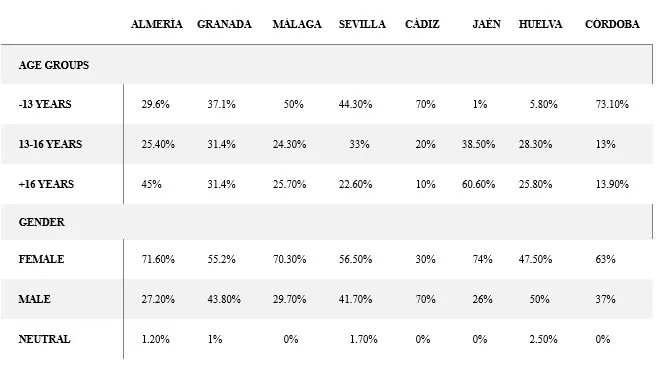 Convenience sampling was used. The principal investigator contacted school nurses at various educational centers, who subsequently informed families about the study through parent-teacher associations. Participation was voluntary. No specific rationale was given for the specific selection of educational centers, which may limit the representativeness of the sample. Inclusion and exclusion criteria
Instruments The following instruments were used for data collection:
Procedure To collect quantitative data, we first contacted the schools. Then, we sent the study information to the families and asked for the legal guardians' informed consent and the minors' assent. The questionnaires were given out at the schools. For the qualitative phase, interviews were conducted with 12 teachers and specialists in the field to gather their perceptions of adolescent self-care (6 women and 6 men) aged between 35 and 50 years. Data analysis The analytical plan was adapted to the nature of the data and the objectives of the study. SPSS software was used for quantitative analysis. The following analyses were performed:
For the qualitative analysis, a thematic content analysis of the interview transcripts was conducted. ATLAS.ti software (version 22) was used to facilitate data coding and the identification of emerging categories and patterns. Ethical considerations The study was approved by the Bioethics Committee of the University of Almería (ref: UALBIO2022/038). The principles of the Declaration of Helsinki were followed. Informed consent was obtained from legal guardians and assent from minors prior to participation. Anonymity and confidentiality of data were guaranteed, ensuring their exclusive use for research purposes. Results Quantitative results Overall results of the PGJ questionnaire The mean scores obtained in the population analyzed were considered average for the physical and psychological practice dimensions. In contrast, the mean scores were high for the social practice and self-care management dimensions. Analysis by self-care dimension Physical Practice: Data on risk behaviors (Table 1) showed that alcohol consumption was the most widespread behavior. Table 2. Risk behaviors (%). 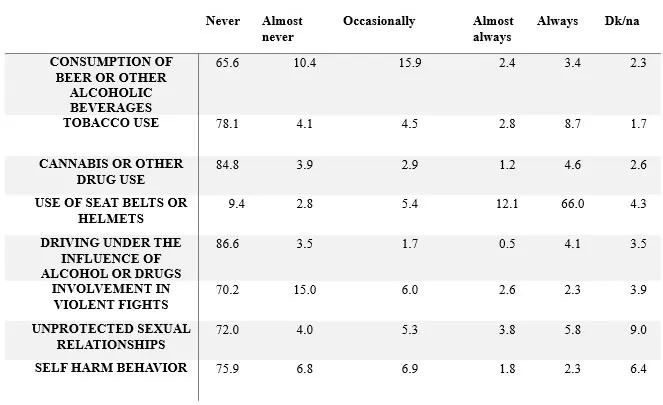
Differences by age and gender The ANOVA analysis revealed significant differences based on age and gender:
Influence of family support The results of the cross-tabulation showed a statistically significant relationship between the perception of family support and the four dimensions of self-care: physical practice, social practice, psychological practice, and self-care management.
While these statistical patterns are unambiguous, their true magnitude and underlying dynamics can only be fully understood through the experiences of professionals who interact with young people on a daily basis. Risk of EDs and NEA
Impact of COVID-19 Analysis of the perceived changes after the pandemic showed a mixed impact. Improvements were reported in areas such as physical activity and social relationships, but more moderate changes or stagnation were observed in indicators such as sleep quality and relationship with oneself. Qualitative Results Thematic content analysis of the teacher interviews, conducted with ATLAS.ti, identified four central categories: self-harm and dangerous behaviors, emotion management, healthy habits, and healthy social relationships. The teachers interviewed placed these categories within three main frameworks that influence adolescent behavior: family, peers, and school. The key finding of the qualitative analysis was the constant interrelation among all categories and subcategories. The interviewees described these phenomena in a dynamic and connected way, highlighting the need for a comprehensive approach to promoting self-care, considering the simultaneous influence of the different frames of reference and the various dimensions of youth well-being. Discussion This section interprets the results presented, contextualizes them within the framework of existing scientific literature, acknowledges the methodological limitations of the study, and proposes future lines of research to advance the understanding of adolescent self-care. The study findings indicate that self-care among Andalusian youth is a multidimensional phenomenon with a heterogeneous profile. The physical dimension, with average levels, reflects a worrying pattern previously identified in national studies: low adherence to recommended physical activity, especially among female adolescents, and sleep quality compromised by the use of electronic devices (27). A gender difference in physical activity was observed, in line with prior studies (27,28), which could reflect different socialization patterns where males are more involved in physical exercise and females are more inclined towards hygiene and nutrition. The negative influence of age on physical activity suggests that the transition to later stages of adolescence coincides with a decline in active habits. On a psychological level, the coexistence of acceptable self-esteem with poor emotional management is a notable finding. This finding underscores the need for interventions that not only reinforce self-esteem, but also equip young people with tools for emotional regulation. Concerning the social dimension, the findings reaffirm the central role of the family as a pillar of emotional support, followed by peers. This is consistent with the literature that highlights the importance of emotional bonds as a protective factor during adolescence. A central finding of this study is the confirmation of the significant influence of family support in all dimensions of self-care. This result reinforces the idea that a cohesive and communicative family environment acts as a key facilitator for the development of healthy habits. Likewise, the association found between low psychological self-care and an increased risk of EDs and NEA provides valuable empirical evidence. This association suggests that risk behaviors such as EDs and NEA may not be isolated issues of body image or exercise, but rather manifestations of underlying deficits in emotional management skills. Extreme control over food or exercise may function as a maladaptive coping strategy to compensate for an inability to regulate internal emotional states, a hypothesis that reinforces the need for interventions focused on emotional competence as primary prevention. Limitations of the study It is important to acknowledge certain limitations that may affect the interpretation and generalization of the results:
Future lines of research Based on the findings and limitations of this study, the following future lines of research are proposed:
In short, this study provides a valuable snapshot of youth self-care and highlights the interconnection between its different dimensions, serving as a starting point for future research and preventive interventions. Conclusions This section presents the conclusions drawn directly from the results and discussion of the study. It summarizes the most relevant findings and their practical implications for health promotion among adolescents.
In this context, the validated PGJ questionnaire is presented as a promising tool for the early detection of these vulnerabilities in the educational setting. Ultimately, there is a clear need to adopt a comprehensive and coordinated approach that actively involves families and educational institutions in order to effectively promote healthy lifestyle habits and strengthen young people's skills.
References |
|
1. Berbiglia VA, Thuy LT. Capítulo 14. Dorothea E. Orem: teoría del déficit de autocuidado en enfermería. In: Modelos y Teorías en Enfermería. Barcelona: Elsevier; 2022. pp. 198-212. 2. Taylor SG, Compton A, Donohue-Eben J, Emerson S, Nergess N, Marriner-Tomey A. Introducción al análisis de las teorías de enfermería. In: Modelos y teorías en enfermería. 4ª ed. Madrid: Ediciones Harcourt; 2000. pp. 9-13. 3. Consejería de Sanidad, Presidencia y Emergencias (Andalucía). Programa educativo Hábitos de Vida Saludable. Modalidad "Creciendo en Salud". Sevilla: Consejería de Sanidad, Presidencia y Emergencias; [Date unknown]. Available from: https://www.juntadeandalucia.es/organismos/sanidadpresidenciayemergencias/areas/sanidad/salud-vida/programas-salud/paginas/creciendo-salud.html [Accessed 2024 Sept 12] 4. Ministerio de Sanidad (España). Campañas. Madrid: Ministerio de Sanidad; [Date unknown]. Available from: https://www.sanidad.gob.es/campannas/portada/home.htm [Accessed 2024 Sept 12] 5. Rodríguez Cabrera A, Sanabria Ramos G, Contreras Palú ME, Perdomo Cáceres B. Estrategia educativa sobre promoción en salud sexual y reproductiva para adolescentes y jóvenes universitarios. Rev Cubana Salud Pública. 2013;39(1):161–74. Available from: http://scielo.sld.cu/scielo.php?script=sci_arttext&pid=S0864-34662013000100015 [Accessed 2024 Sept 12] 6. Gallardo López L, Monroy Rodríguez G. El autocuidado y las apps, agentes de cambio en enfermedades como sobrepeso, obesidad y diabetes. Rev Digit Univ. 2017;18(8). http://doi.org/10.22201/codeic.16076079e.2017.v18n8.a3 7. Ruiz-Aquino MM, Díaz-Lazo A, Ortiz-Aguí ML, Enit Ida VC. Conductas de autocuidado frente a la prevención del contagio de la COVID-19 en pobladores peruanos. Rev Cubana Med Gen Integr. 2021;36(4). Available from: https://revmgi.sld.cu/index.php/mgi/article/view/1708 [Accessed 2024 Oct 05] 8. Asociación Española de Pediatría. Los adolescentes españoles tienen una percepción muy optimista de su estado de salud, según la encuesta “te cuidas tanto como crees”, de la Asociación Española de Pediatría. Madrid: Asociación Española de Pediatría; 26 de octubre de 2020. Available from: https://static.aeped.es/20201026_np_encuesta_adolescentes_49aa8766c9.pdf [Accessed 2024 Sept 12] 9. De Valenzuela Bandín AL, Martínez García R, Escobar Arias DM. Prácticas de ocio y tiempo libre de los adolescentes en Galicia: análisis y reflexiones en clave socioeducativa. Bordón. 2021;73(1):161-77. https://doi.org/10.13042/Bordon.2021.83201 10. Hernández Serrano O, Espada Sánchez JP, Orgilés M, García Fernández JM. Programa de prevención del consumo de drogas Saluda: evaluación de una nueva versión en adolescentes españoles. Salud y Drogas. 2013;13(2):135-44. https://doi.org/10.21134/haaj.v13i2.210 11. López Iglesias M, Tapia-Frade A, Ruiz Velasco CM. Patologías y dependencias que provocan las redes sociales en los jóvenes nativos digitales. Rev Comun Salud. 2023;13:1-21. https://doi.org/10.35669/rcys.2023.13.e301 12. Garcés-Rimón M, Miguel Castro M. Hábitos de vida saludable desde la adolescencia. Rev Estud Juventud. 2016;112:107-16. Available from: https://www.injuve.es/sites/default/files/revista112_8.pdf [Accessed 2024 Oct 05] 13. Pool-Góngora RA, Balam-Gómez M, Tuyub-Itza MY. Planes de cuidados de enfermería: propuesta para padres con escolares que padecen sobrepeso u obesidad. Sanus. 2023;8(19):e301. https://doi.org/10.36789/revsanus.vi1.301 14. Santiago Bitria M. Programa de formación sobre el autocuidado y gestión de emociones del profesional sanitario en la unidad de Cuidados Paliativos Pediátricos (CPP). Zaragoza: Universidad de Zaragoza; 2022. Available from: https://zaguan.unizar.es/record/112626 [Accessed 2024 Oct 05] 15. Nuño-Solinis R, Rodríguez-Pereira C, Piñera-Elorriaga K, Zaballa-González I, Bikandi-Irazabal J. Panorama de las iniciativas de educación para el autocuidado en España. Gac Sanit. 2013;27(4):332–7. http://doi.org/10.1016/j.gaceta.2013.01.008 16. García Reyes AL, Salgado Guadarrama JD. Valoración de enfermería en el autocuidado y estilo de vida del paciente con enfermedad crónica asociada a la obesidad. Dilemas Contemp Educ Polit Valores. 2022;9(2):105. https://doi.org/10.46377/dilemas.v9i2.3154 17. Achury DM, Kato NP. Adaptación cultural del Cuestionario de autocuidado en pacientes con asistencia ventricular definitiva. Enferm Global. 2023;22(2):234-56. https://doi.org/10.6018/eglobal.526611 18. Alania Chavez M. Gestión de conocimiento y autocuidado en pacientes trasplantados de células progenitoras hematopoyéticas, INEN - 2021 [Tesis de Maestría]. Lima: Universidad César Vallejo; 2021. Available from: https://hdl.handle.net/20.500.12692/72343 [Accessed 2024 Oct 07] 19. León-Larios F, Gómez-Baya D. Diseño y validación de un cuestionario sobre conocimientos de sexualidad responsable en jóvenes. Rev Esp Salud Pública. 2020;92:e20180628. Available from: https://www.sanidad.gob.es/biblioPublic/publicaciones/recursos_propios/resp/revista_cdrom/VOL92/ORIGINALES/RS92C_201806028.pdf [Accessed 2024 Oct 09] 20. Videra-García A, Reigal-Garrido RE. Autoconcepto físico, percepción de salud y satisfacción vital en una muestra de adolescentes. Anal Psicol. 2013;29(1):141–7. https://doi.org/10.6018/analesps.29.1.132401 21. Campos-García A, Oliver A, Tomás JM, Galiana L, Gutiérrez M. Autocuidado: nueva evidencia sobre su medida en adultos mayores. Rev Esp Geriatr Gerontol. 2018;53(6):326-31. https://doi.org/10.1016/j.regg.2018.01.010 22. Canty-Mitchell J, Zimet GD. Psychometric properties of the Multidimensional Scale of Perceived Social Support in urban adolescents. Am J Community Psychol. 2000;28(3):391-400. https://doi.org/10.1023/a:1005109522457 23. Cheng S-T, Chan ACM. The Multidimensional Scale of Perceived Social Support: Dimensionality and age and gender differences in adolescents. Personal Individ Differ. 2004;37(7):1359–69. https://doi.org/10.1016/j.paid.2004.01.006 24. Camacho Vargas S. Propiedades psicométricas de la Escala de Apoyo Social Percibido de Zimet en adolescentes de un centro juvenil, Lima – 2024. Lima: Universidad Norbert Wiener; 2025. Available from: https://repositorio.uwiener.edu.pe/entities/publication/cff2b4f7-b506-4d61-b95d-c54318b6aa98 [Accessed 2024 Oct 09] 25. Garcia-Campayo J, Sanz-Carrillo C, Ibañez JA, Lou S, Solano V, Alda M. Validation of the Spanish version of the SCOFF questionnaire for the screening of eating disorders in primary care. J Psychosom Res. 2005 Aug;59(2):51-5. https://doi.org/10.1016/j.jpsychores.2004.06.005 26. Sicilia Á, Alías-García A, Ferriz R, Moreno-Murcia JA. Spanish adaptation and validation of the Exercise Addiction Inventory (EAI). Psicothema. 2013;25(3):377-83. https://doi.org/10.7334/psicothema2013.21 27. Moreno C, Ramos P, Rivera F, Sánchez-Queija I, Jiménez-Iglesias A, García-Moya I, et al. La adolescencia en España: salud, bienestar,familia, vida académica y social. Resultados del Estudio HBSC 2018. Madrid: Ministerio de Sanidad; 2020. Available from: https://www.sanidad.gob.es/areas/promocionPrevencion/entornosSaludables/escuela/estudioHBSC/2018/docs/HBSC2018_ResultadosEstudio.pdf [Accessed 2024 Oct 09] 28. News Tercera Edad. VI Barómetro sobre el Autocuidado de la población española (realizado por Pic Soluction). News Tercera Edad. 25 de abril de 2023. Available from: https://www.news3edad.com/2023/04/25/vi-barometro-sobre-el-autocuidado-de-la-poblacion-espanola/?utm_source=chatgpt.com [Accessed 2024 Oct 05] |
Enfermería Cuidándote. 2026; 9